

The Three Barriers That Strand Good Research

You've been in this meeting. A product decision gets made, and you're sitting there knowing, with evidence, that it's the wrong call. You ran the sessions six weeks ago. The findings were clear. The report was thorough. It went into the shared drive and, apparently, stayed there.
The problem here isn't bad research. It's what happens to good research in organizations that haven't built the conditions for it to travel.
Three barriers show up again and again when solid research fails to move anything. They aren't mysterious, and they aren't unique to your company. But until you name them, you can't do much about them.
Share POst


.png)

Barrier 1: Culture and Organizational Inertia
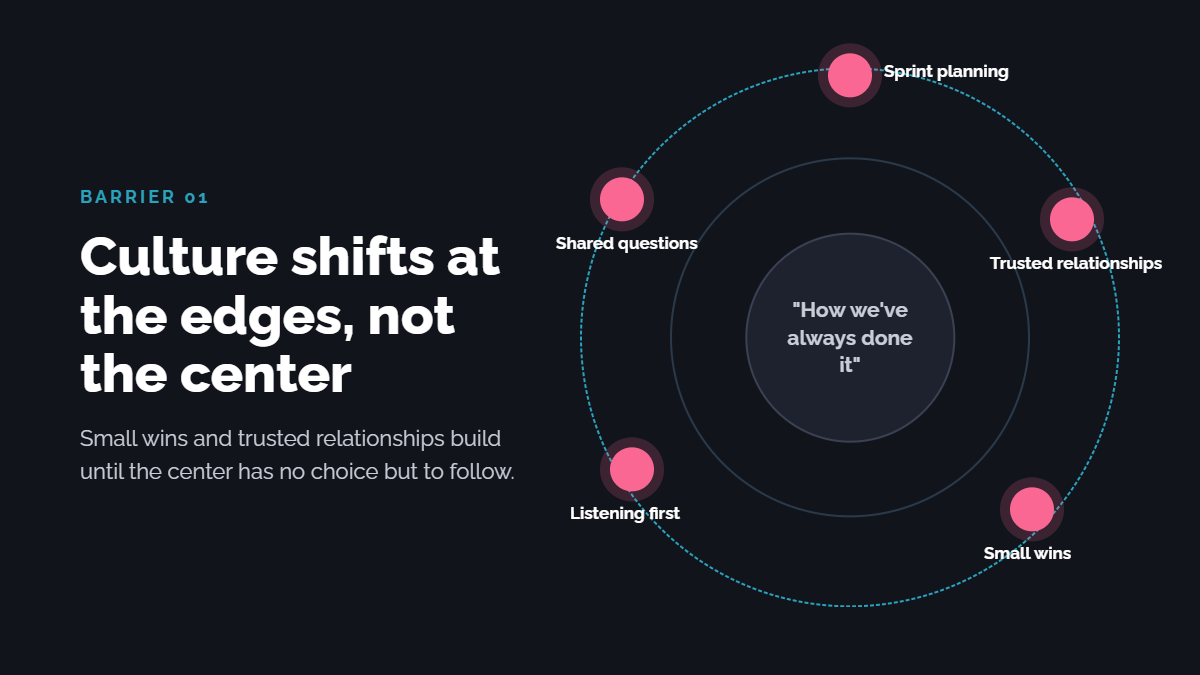
Real culture lives in the unspoken agreements, the invisible layers of approval, and the "this is just how we do things here" that greets every new idea with quiet resistance. It rarely matches what's on the intranet.
In practice, this looks like a product team that has made decisions by instinct and internal debate for years. Research arrives, and everyone agrees it's valuable. Then it barely changes the conversation. Nobody is hostile to it; the existing grooves just run deep. Decisions happen where research isn't present: in hallway conversations, in Slack threads, in the 15 minutes before a meeting officially starts.
A mid-sized SaaS company hired its first dedicated UX researcher after years of relying on ad hoc customer calls from the sales team. The researcher was talented and productive, turning out five solid studies within three months. Within six months, they were questioning whether to stay. The work was strong, but the organization had a decade of decision-making momentum with no research step in it. Findings shared in Slack got thumbs-up reactions and rarely showed up in actual product decisions.
What eventually moved the needle was a change in how the researcher showed up. They started attending sprint planning, not to present but to listen. They asked engineering leads which questions they were carrying into the next quarter, and they built the relationships that eventually made their research feel like something the team had a stake in, rather than something delivered from outside.
Culture shifts at the edges, not the center: through small wins and trusted relationships, until the center has no choice but to follow.
Barrier 2: Stakeholder Timing and Fit
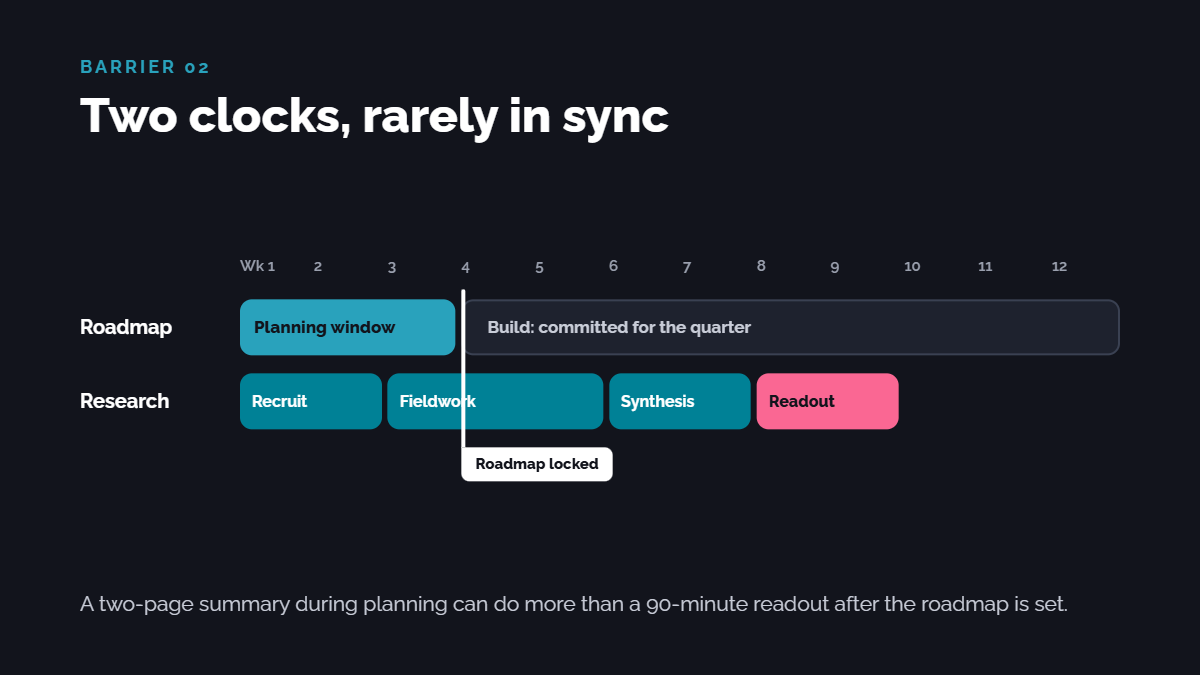
Researcher timelines are driven by rigor: recruitment, fieldwork, synthesis, reporting. Stakeholder timelines are driven by quarterly OKRs, roadmap planning cycles, and the relentless pressure to ship. These two clocks rarely run in sync. Research that arrives two weeks after a roadmap is locked still has value, but it's fighting decisions that have already hardened into commitments.
At a financial services company, a research team spent eight weeks studying their mobile onboarding experience. The findings were significant: twelve distinct friction points, clearly documented, with severity ratings and recommended fixes. They presented to the product org in a 90-minute readout. The response was polite and largely noncommittal.
What the team learned later: the product director had already committed the engineering team's quarter. The roadmap was set. The readout, however thorough, arrived after the window for influence had closed. A two-page summary sent to the director three weeks earlier, during planning, would likely have changed the outcome.
Fit matters as much as timing. A VP of Product who controls the roadmap has different incentives and pressures than the developer implementing your recommendations, the designer translating them into interfaces, or the customer success manager who hears from users every day. One output, delivered the same way to all of them, will land differently for each.
Managing stakeholders well has less to do with politics than with preparation. Researchers who map their key stakeholders before a study begins, knowing each person's goals, pressures, and decision windows, consistently get more traction than those who treat delivery as the end of the job.
Barrier 3: The Missing Link to Business Outcomes
Most researchers already know this one: "We need to connect our findings to business metrics." True, and incomplete.
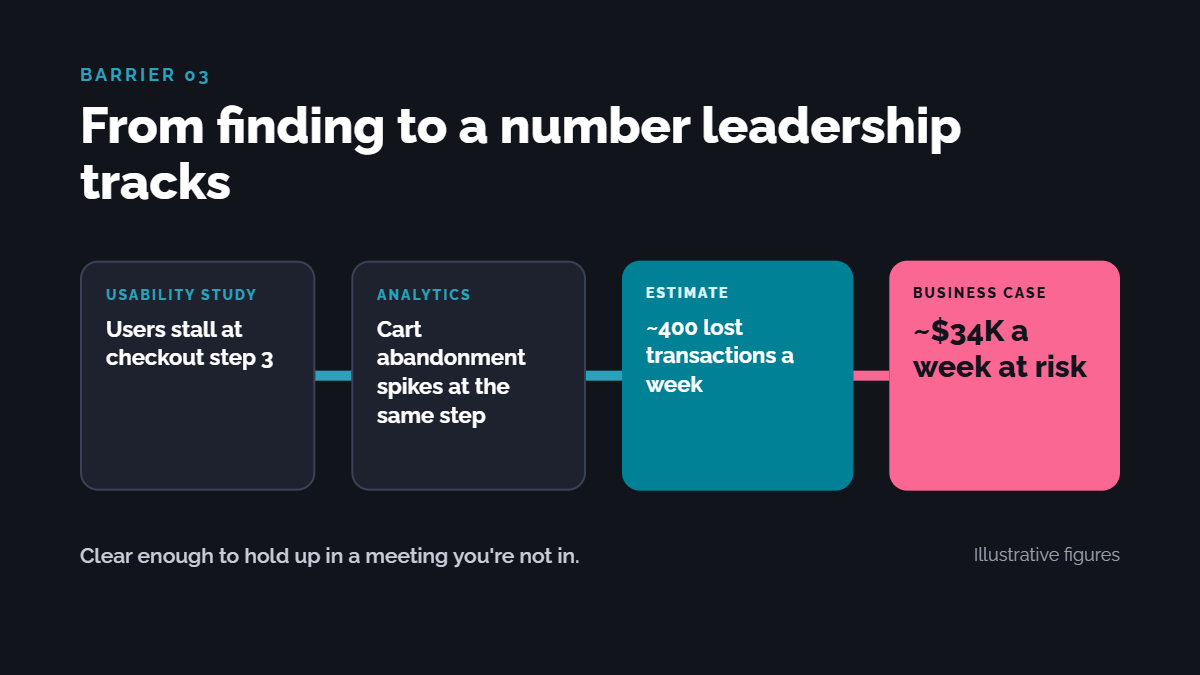
Adding a revenue number to a usability finding is only the start. The real task is building an evidence chain so clear and specific that a non-researcher can follow it without your help. In most organizations, your research will be presented by someone else, to someone else, in a meeting you're not in. If the link to business outcomes needs your narration to hold together, it won't.
The deeper problem is that many research reports are designed to be comprehensive rather than persuasive. They document what was found. They rarely argue why it matters to the specific person who controls the budget, the roadmap, or the engineering capacity. Those are different documents with different jobs, and most teams write only the first.
A UX team at an e-commerce company had raised concerns about a checkout flow for over a year. The research was solid: task completion rates, error frequencies, qualitative accounts of user frustration. Leadership acknowledged it, and nothing changed. The research had documented a user experience problem without making a business case.
Resources finally came when a researcher pulled cart abandonment data from the analytics team, matched it against the friction points in the usability study, and built a one-page brief. "Users struggle to complete checkout" became something like "we're losing an estimated 400 transactions a week at this step, at an $85 average order value." The research hadn't changed. What changed was its connection to a number leadership already tracked.
That's not spin. That's the work. Findings that can't answer "what does this cost us to or not to fix?" will keep losing to priorities that can.
What These Barriers Have in Common

None of them is about the quality of the research.
The most rigorous study, run by the most skilled researcher, can be stopped by any one of them. The organizations that get the most from research aren't always running the most sophisticated studies. They've built the surrounding conditions: the relationships, the timing instincts, the habit of translating findings into the language of business decisions. That's how they close the research-to-decision gap.
That work is less visible than the research itself. It doesn't show up in a report. But it's what separates research that shapes strategy from research that shapes the shared drive.
Making Experience Research Actionable is a practical guide for UX researchers navigating exactly these challenges. [Download it free]
Xperius is a research intelligence platform closing the gap between insight and decision
If your team is spending time and money re-running research you've already done, it's time for a new approach. Xperius can help you better organize, share, and activate your research.

